Quick Answer
Pharma trade show booth catering and staffing are the two on-floor hospitality elements that drive healthcare professional (HCP) dwell time, lead qualification, and brand engagement at medical conferences. Effective hospitality programs comply with the PhRMA Code on modest meals. Trained brand ambassadors qualify leads, manage traffic, and hand off HCPs to field staff. Both are measured through cost-per-engagement tracked in CRM.
Key Highlights
- Booth catering and brand ambassador staffing are the two primary on-floor hospitality elements at pharma trade shows.
- All booth catering must comply with the PhRMA Code: meals must be modest, tied to a real business or educational purpose, and free of alcohol.
- Catering service timing and restocking matter as much as the menu — a booth that runs out of food by mid-morning loses its engagement advantage for the rest of the day.
- Pharma-ready brand ambassadors require compliance training, product familiarity, and a defined handoff protocol before the show opens.
- Cost-per-engagement (total spend divided by qualified HCP interactions) is the primary ROI metric for catering and staffing programs.
- Exhibit houses that manage catering and staffing as a bundled service eliminate vendor fragmentation and reduce compliance risk for pharma clients.
- Booth catering and staffing spend may trigger Sunshine Act Open Payments reporting obligations — document all expenditures before, during, and after each show.
What’s Ahead

Pharmaceutical trade shows draw tens of thousands of healthcare professionals every year. Events like the BIO International Convention and ASHP Midyear Clinical Meeting pack prescribers, researchers, and clinical decision-makers into convention halls for a few intense days.
Every pharma brand at those shows faces the same challenge: getting HCPs to stop, stay, and engage. Two elements determine whether that happens — your catering and your staff.
This guide is written for pharma brands and the exhibit houses that serve them. You will learn how to plan, execute, and measure compliant booth catering and brand ambassador staffing programs that turn foot traffic into qualified HCP relationships.
What Is Pharma Trade Show Booth Catering and Staffing?
Pharma trade show booth catering and staffing are the two primary on-floor elements that drive HCP engagement at medical conferences.
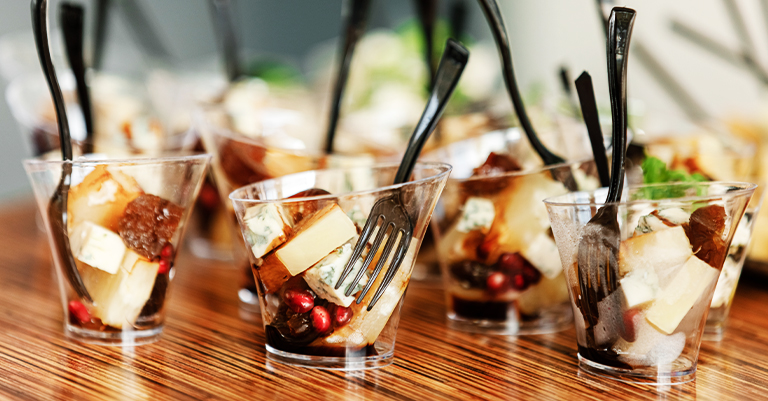
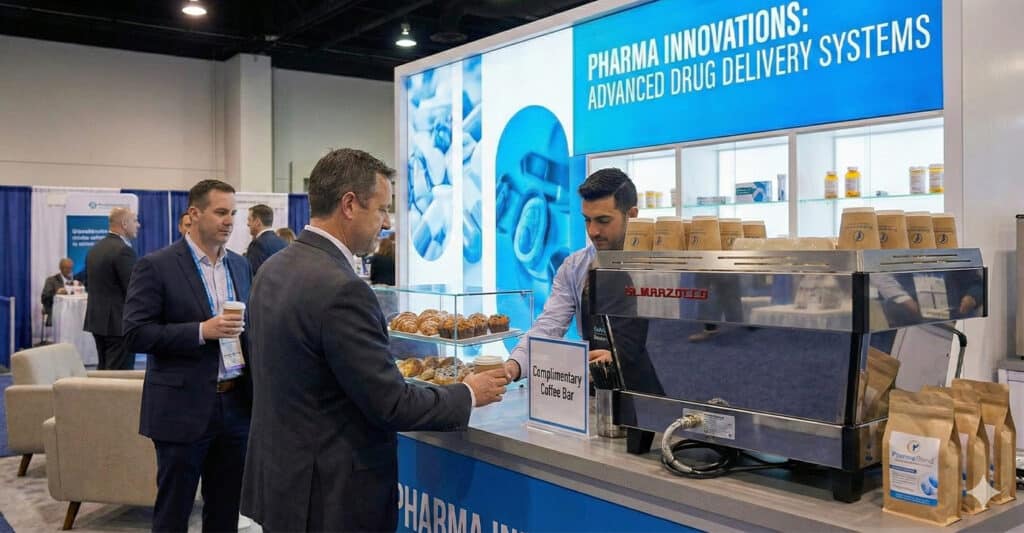
Booth catering covers every food and beverage service offered at the exhibit — from morning coffee to afternoon refreshment stations to catered presentations. Done well, it gives HCPs a reason to stop and creates natural conversation time.
Brand ambassador staffing covers every person working the floor on behalf of the pharma brand — greeting visitors, qualifying leads, managing traffic flow, and routing HCPs to the right conversation.
These two elements work together. Catering draws HCPs in. Staffing converts that attention into a qualified interaction.
Both require deliberate planning and must comply with the PhRMA Code on Interactions with Healthcare Professionals from the start.
Why Catering and Staffing Matter at Medical Conferences
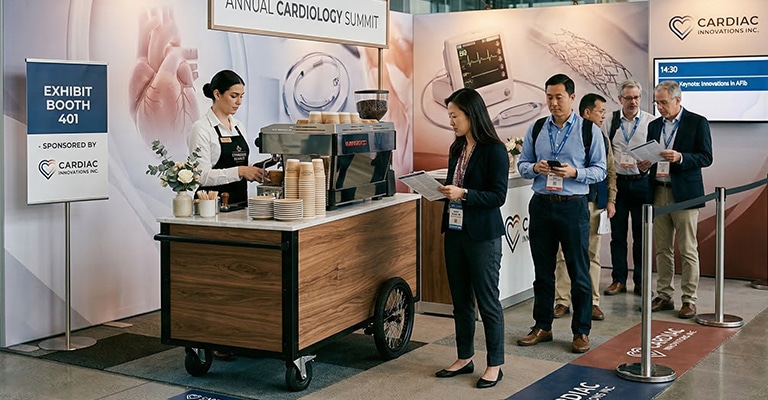
HCPs attend medical conferences with packed schedules. They balance scientific sessions, peer networking, and exhibit hall time across multiple days. Without a compelling reason to stop at your booth, they keep walking.
Catering gives them a reason to stop. Staffing gives them a reason to stay.
Here is why these two elements are especially important in pharma:
- Differentiation: Many pharma brands arrive with similar booth designs and messaging. A well-staffed booth with quality catering creates a distinct, memorable experience that competitors without it cannot match.
- Lead quality: A trained brand ambassador qualifies every HCP who visits. Without active staffing, badge scans are collected but conversations are lost. Staffing turns traffic into data.
- Dwell time: HCPs who linger at your booth are more likely to engage in a substantive conversation and request follow-up. Catering directly increases dwell time.
- Pipeline conversion: Booth-level catering and staffing programs drive higher-quality post-show follow-up than passive exhibit presence alone.
99% of marketers report finding unique value from trade shows that they cannot get from other marketing channels. In pharma, catering and staffing are what separate a memorable booth from a forgettable one (CEIR).
Booth Catering: Formats, Timing, and Compliance
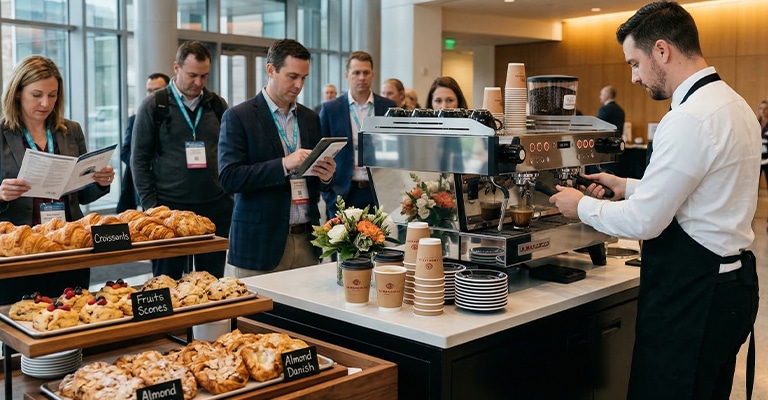
Booth catering is the most visible and immediately impactful on-floor hospitality element. It gives HCPs a reason to stop, stay, and start a conversation. A booth with well-executed food service consistently outperforms one without it for dwell time and lead volume.
Catering Formats That Work
Not all catering serves the same purpose. Match the format to the moment:
- Morning coffee and espresso service: Timed to the show floor opening. Coffee creates immediate traffic and gives brand ambassadors a natural opening line.
- Branded snack stations: Light refreshments available throughout the day. Keeps the booth active between peak hours and gives returning visitors a reason to stop again.
- Catered presentations: Lunch or afternoon food tied to a product demo or brief. Extends dwell time and anchors the HCP in place for a structured conversation.
- Afternoon refreshment resets: A mid-afternoon refresh pulls in HCPs who missed the morning service and re-engages those who visited earlier.
Timing and Restocking
Timing matters as much as the menu. Catering that runs out by 10am or is not restocked after lunch loses its engagement value for the rest of the day.
Staff the catering station throughout show floor hours. Do not rely on a single morning delivery. Build restocking checkpoints into your logistics plan at the same time you confirm the menu.
Catering Compliance Rules
All booth catering must comply with the PhRMA Code. The rules are straightforward:
- Meals must be simple and directly tied to a real business or educational meeting — not a perk or reward
- No alcohol at booth catering stations
- No elaborate multi-course service that could be construed as entertainment
- No catering items of personal monetary value to the HCP
Booth catering spend may trigger Sunshine Act Open Payments reporting obligations. Document every expenditure. Work with your compliance team to determine which items are reportable before the show.
Catering as a Logistics Operation
For exhibit houses, booth catering is not a food order — it is a logistics operation. That means managing vendor sourcing, menu approval, delivery scheduling, on-site restocking coordination, service staffing throughout the day, and post-show waste disposal.
A catering failure on the show floor reflects directly on the exhibit house. Treat it with the same operational rigor as the booth build itself.
Brand Ambassador Staffing: Roles, Training, and Execution
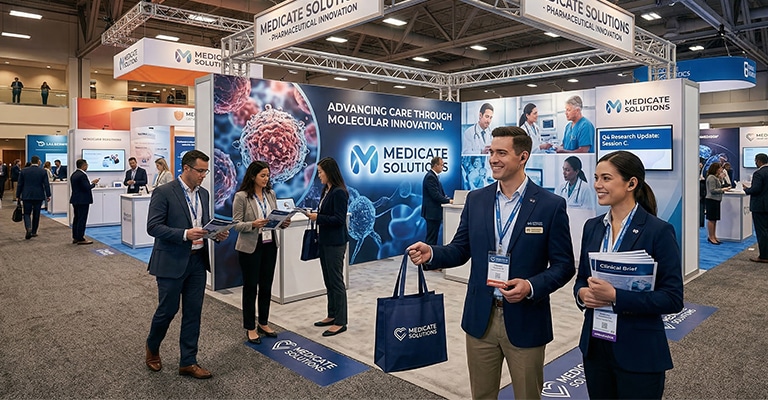
Brand ambassadors are the face of your pharma booth. They manage traffic flow, qualify HCP leads, and guide visitors toward the right next step. 85% of exhibitors say the quality of their booth staff significantly influences their show’s success (EXHIBITOR Magazine).
What Makes a Pharma-Ready Brand Ambassador
Pharma-ready brand ambassadors are different from general trade show staff. They need:
- Compliance training: They know exactly what they can and cannot say. Brand ambassadors do not deliver clinical information or discuss off-label uses. That line must be established and practiced before the show opens.
- Product familiarity: They understand the brand, the therapeutic area, and the key messages. They do not need to know the science in depth — they need to know enough to qualify interest and route the conversation correctly.
- Lead qualification skills: They capture badge scans, note conversation context, and flag high-priority leads in real time. Every interaction should produce a record, not just a handshake.
- Traffic management: They keep the booth flowing. That means greeting arrivals, managing wait times at catering stations, and preventing dead zones where no one is being engaged.
- Handoff protocol: When an HCP needs a deeper clinical conversation, the brand ambassador hands off cleanly to the pharma client’s MSL or field rep. That handoff needs a defined trigger and a practiced script.
Pre-Show Staff Preparation
Brand ambassadors should not learn the program on the show floor. Pre-show preparation includes:
- Written brand brief covering key messages, therapeutic area context, and conversation boundaries
- Compliance briefing covering PhRMA Code rules and what topics to redirect to the pharma client’s field team
- Handoff rehearsal with the pharma client’s MSLs or field reps so both sides understand the trigger and the protocol
- Lead retrieval system training so every badge scan is logged with the right context notes from the start
The Exhibit House Staffing Role
For exhibit houses, brand ambassador staffing means recruiting, vetting, training, and managing this team on-site from setup through teardown. The pharma client should never have to manage their own staffing vendor at the show. That coordination belongs with the exhibit house.
Keeping staffing and catering with a single exhibit house partner eliminates a coordination gap that often leads to on-floor failures when multiple vendors are involved.
Compliance: The PhRMA Code and Sunshine Act

Every pharma booth catering and staffing program must comply with the PhRMA Code on Interactions with Healthcare Professionals. For booth-level programs, these are the rules that matter most.
| Requirement | What It Means for Catering and Staffing |
| Modest meals only | Food and beverage must be simple and tied to a real business or educational context — not a perk, reward, or entertainment substitute |
| No alcohol | Alcohol is not permitted at booth catering stations under any circumstances |
| No entertainment | Catering cannot be paired with concerts, sporting events, or recreational activities — even informally |
| Restricted gifts | Branded items with monetary value are prohibited — brand ambassadors cannot distribute giveaways that cross into gift territory |
The Sunshine Act (CMS Open Payments) requires pharma companies to report payments and transfers of value to HCPs. Booth catering spend — including meals and food service — may be reportable. Brand ambassador staffing costs generally are not, but any item of value provided directly to an HCP as part of a staffing interaction can trigger reporting. Document every expenditure.
Additional compliance risk frameworks are available for teams seeking a deeper review before each show (e.g., HHS OIG Compliance Guidance for Pharmaceutical Manufacturers).
If your catering or staffing program includes any transfer of value to an HCP, assume it is reportable until your compliance team confirms otherwise. Build that review into every pre-show planning cycle.
Planning Your Catering and Staffing Program

A strong pharma catering and staffing program starts with a clear plan built well before the show. The decisions you make in the planning phase determine whether your booth drives qualified engagement or just foot traffic.
Follow this six-step process:
- Set engagement goals. Define how many HCP conversations you need and what a qualified interaction looks like. This drives every downstream decision about staffing levels and catering volume.
- Select your catering formats. Match the format to your show schedule. A full-day show needs morning service, mid-day restocking, and an afternoon reset. A half-day show may need only one service window.
- Assign and brief your staff. Recruit brand ambassadors with pharma event experience. Build the compliance brief, the product brief, and the handoff protocol before the show opens — not at the venue.
- Confirm vendor logistics. Lock catering vendor, delivery schedule, restocking checkpoints, and service staffing before the show. Late vendor confirmations are one of the most common causes of on-floor catering failures.
- Run a compliance review. Check every catering menu item and every brand ambassador brief against the PhRMA Code before signing any contracts.
- Integrate lead capture. Configure lead retrieval systems before the show opens. Every brand ambassador should scan badges and enter conversation context notes in real time, not at end of day.
Use this checklist before every show:
| Pre-Show Task | |
| ☐ | Engagement goals and qualified interaction definition documented |
| ☐ | Catering formats selected and matched to the show schedule |
| ☐ | Catering vendor confirmed, menu approved, delivery schedule locked |
| ☐ | Restocking checkpoints built into the logistics plan |
| ☐ | Brand ambassadors recruited and confirmed |
| ☐ | Compliance brief, product brief, and handoff protocol written and distributed |
| ☐ | Staff briefing and handoff rehearsal completed |
| ☐ | Lead retrieval system configured and tested |
| ☐ | Compliance review completed and signed off |
If you skip the compliance review, you risk violations that are difficult and expensive to unwind. If you skip the staff briefing, you risk brand ambassadors going off-script on the show floor.
Measuring ROI: Cost-Per-Engagement and Beyond

The most important ROI metric for pharma booth catering and staffing is cost per engagement. This figure tells you exactly what each qualified HCP interaction actually costs.
Use this formula:
Cost-Per-Engagement = Total Catering and Staffing Spend divided by Total Qualified HCP Interactions
To calculate accurately, you need two primary data sources:
- Lead retrieval scan data from brand ambassador interactions — with conversation context notes, not just badge scans
- Post-show CRM entries tied to specific booth touchpoints, including which interactions converted to follow-up meetings or pipeline activity
Beyond cost-per-engagement, track these secondary metrics:
- Staff conversion rate: What percentage of brand ambassador conversations produced a badge scan, a meeting request, or a post-show follow-up? This tells you whether your staffing quality and catering draw are generating qualified engagement or just traffic.
- Dwell time: How long are HCPs staying at the booth? Longer dwell time correlates with better lead quality. Catering restocking timing and staffing attentiveness both directly affect this metric.
- Repeat engagement: Did HCPs from last year’s show return to this year’s booth? Repeat visits signal that your catering and staffing program left a strong enough impression to earn a second interaction.
- Pipeline influence: Did booth interactions advance formulary reviews (decisions by health systems on which drugs to cover) or prescribing conversations downstream?
Most pharma brands underinvest in post-show measurement. If you cannot connect catering and staffing spend to pipeline outcomes, you cannot defend the budget next year.
How Exhibit Houses Deliver Catering and Staffing
Exhibit houses are the operational backbone of pharma booth catering and staffing. A capable exhibit house does not just build the booth. It sources the catering vendor, trains the brand ambassadors, and manages both on-site from setup through teardown.
Here is what a turnkey pharma catering and staffing partner delivers:
- Catering coordination: Vendor sourcing, PhRMA-compliant menu planning, delivery scheduling, on-site restocking, service staffing throughout show hours, and post-show waste management.
- Brand ambassador staffing: Recruiting, vetting, compliance briefing, product briefing, handoff rehearsal, and on-site management of the full booth staff team.
- Booth design with integrated catering zones: Branded food service stations, seating areas, and traffic flow layouts built into the exhibit footprint so catering and staffing work together, not around each other.
- Lead retrieval integration: Configuring and managing the lead capture system so every brand ambassador interaction is logged with the right context from the first badge scan.
- Compliance documentation: Tracking all catering and staffing expenditures to support Open Payments reporting and post-show compliance review.
Pharma clients who manage catering and staffing through separate vendors face coordination gaps that frequently cause on-floor failures — a catering delivery that conflicts with setup, or a brand ambassador team that has not been briefed on the current product message.
As an exhibit house, catering and staffing are your highest-value differentiators. Pharma clients who trust you with both rarely go looking for other partners. That is the account relationship that grows.
Key Mistakes to Avoid
Even experienced pharma exhibitors make costly, avoidable errors in catering and staffing. Here are the six most common ones.
Skipping the Compliance Review
Every catering menu and every brand ambassador brief needs a PhRMA Code review before any contract is signed or any training begins. Running the review late creates legal exposure that is difficult and expensive to unwind.
Treating Catering as an Afterthought
Catering that is ordered at the last minute, not restocked, or not matched to show hours, fails visibly on the floor. Start vendor sourcing and menu planning at the same time as booth design, not after it.
Understaffing the Catering Station
A catering station with no one managing it becomes a mess, runs out faster, and stops driving engagement. Assign dedicated catering support staff separate from your brand ambassadors so each can focus on their role.
Sending Untrained Brand Ambassadors to the Floor
Brand ambassadors who have not been briefed on compliance boundaries or the handoff protocol create real risk. An off-script comment about a drug’s clinical data — even well-intentioned — can create a regulatory problem. Brief, rehearse, and document before the show opens.
Failing to Log HCP Interactions in Real Time
End-of-day lead entry is unreliable. Context notes get lost, conversations get mixed up, and high-priority leads fall through. Configure lead retrieval before the show and require real-time entry for every brand ambassador interaction.
Skipping the Post-Show Debrief
Without a structured debrief, the same catering and staffing failures repeat at the next show. Schedule a debrief within one week. Review catering performance, staff conversion rates, and compliance incidents before the team disperses.
If your catering and staffing program lacks a documented compliance checklist, you are operating with unnecessary legal and reputational exposure.
People Also Ask
What types of catering are allowed at pharma trade show booths?
Pharma booth catering must comply with the PhRMA Code. Permitted formats include coffee service, branded snack stations, and light refreshments tied to a real business or educational context. Alcohol, multi-course meals, and catering presented as entertainment or a gift are not permitted.
What does a pharma-ready brand ambassador do differently than a standard trade show staffer?
A pharma-ready brand ambassador is trained on compliance boundaries, the therapeutic area, and the handoff protocol to the pharma client’s field staff. They do not deliver clinical information or discuss off-label uses. They qualify leads in real time, manage traffic flow, and hand off HCPs to MSLs or field reps when a deeper scientific conversation is needed.
Does booth catering at a pharma trade show trigger Sunshine Act reporting?
It may. The Sunshine Act (CMS Open Payments) requires reporting of payments and transfers of value to healthcare professionals. Booth catering spend may be reportable depending on the format and dollar thresholds. Work with your compliance team to determine what is reportable before each show and document all expenditures.
How do you measure ROI for booth catering and staffing?
Divide total catering and staffing spend by qualified HCP interactions to calculate cost-per-engagement. Track secondary metrics, including staff conversion rate (what percentage of brand ambassador conversations produced a lead or follow-up), dwell time, and year-over-year HCP return rates. Use real-time lead-retrieval data from brand-ambassador interactions as the primary data source.
What is the handoff protocol between a brand ambassador and a pharma field rep?
The handoff protocol defines the moment when a brand ambassador transfers an HCP conversation to an MSL or field rep — typically when the HCP asks a clinical or scientific question that falls outside the brand ambassador’s brief. The protocol needs a defined trigger, a practiced introduction script, and pre-show coordination between the exhibit house staffing team and the pharma client’s field team.
How much staff does a pharma booth need?
Staffing levels depend on booth footprint, expected traffic volume, and the number of catering stations. A general rule is one brand ambassador per 100 square feet of active exhibit space, with dedicated catering support staff separate from the ambassador team. Your exhibit house can model staffing requirements based on the show’s historical attendance patterns.
Closing Thoughts
Booth catering and brand ambassador staffing are the two on-floor hospitality elements that determine whether a pharma exhibit drives qualified HCP engagement or just traffic. When both are planned, briefed, and executed well, they work together: catering draws HCPs in, staffing converts that attention into relationships and leads.
For exhibit houses, delivering both as a bundled service is a direct competitive advantage. Pharma clients who trust you with catering and staffing, not just the booth build, rarely look for other partners.
Ready to enhance your trade show presence with hospitality? Let us know and we’ll connect you with our team!
FAQ

What is pharma trade show booth catering and staffing?
Pharma trade show booth catering and staffing are the two primary on-floor hospitality elements at medical conferences. Booth catering covers all compliant food and beverage service at the exhibit. Brand ambassador staffing covers every person working the floor on behalf of the pharma brand. Both must comply with the PhRMA Code and may trigger reporting obligations under the Sunshine Act’s Open Payments. Together, they drive HCP dwell time, lead qualification, and the quality of post-show follow-up.
How is pharma booth catering different from standard trade show catering?
Pharma booth catering operates within strict regulatory limits that do not apply to most other industries. The PhRMA Code requires that all food and beverage service be modest, tied to a real business or educational purpose, and free of alcohol. Elaborate meals, entertainment-style catering, and items of personal monetary value to HCPs are not permitted. Standard exhibitors in other industries face none of these constraints, allowing far more flexibility in designing their catering programs.
What does the Sunshine Act require for pharma catering spend?
The Sunshine Act (CMS Open Payments) requires pharmaceutical companies to report payments and transfers of value to healthcare professionals and teaching hospitals. Booth catering spend, particularly food provided directly to HCPs, may be reportable, depending on the format and the dollar thresholds, which are adjusted annually. Your compliance and legal teams should review all catering plans before each show to identify what triggers reporting obligations.
Can pharma companies serve food at their trade show booth?
Yes, with restrictions. Booth catering is permitted under the PhRMA Code when the food is modest and tied to a legitimate business or educational context. Coffee service, light refreshments, and simple meal service during a product presentation are generally acceptable. Alcohol, multi-course dining, and catering framed as entertainment or a gift are not permitted. Always run the specific menu through a compliance review before confirming with a vendor.
What qualifications should a pharma brand ambassador have?
A pharma-ready brand ambassador needs four things before they step onto the show floor: compliance training covering what they can and cannot say under the PhRMA Code; product familiarity with the brand, therapeutic area, and key messages; lead qualification skills including real-time badge scanning and context note-taking; and a clear understanding of the handoff protocol to the pharma client’s field staff. These are not optional — they are the baseline for anyone representing a pharma brand at a medical conference.
How many brand ambassadors does a pharma booth need?
A general guideline is one brand ambassador per 100 square feet of active exhibit space, with dedicated catering support staff separate from the ambassador team. However, the right number depends on booth footprint, expected traffic volume, show hours, and the number of catering stations in operation. Your exhibit house can model staffing requirements based on the show’s historical attendance data and your specific engagement objectives.
What staffing does a pharma booth program require?
A pharma booth program typically requires brand ambassadors for floor-level HCP engagement, catering support staff to manage food service separately from lead generation, and a designated on-site team lead who coordinates between the exhibit house and the pharma client’s field team. Keeping brand ambassadors focused on conversations and separate from catering duties is essential. Each role should have a written brief defining scope, talking points, and compliance boundaries before the show opens.
How do you ensure PhRMA Code compliance for booth catering and staffing?
Build a compliance checklist before any vendor contracts are signed or any staff is briefed. Review every catering menu item against PhRMA Code standards. Review every brand ambassador brief for compliance boundary clarity. Involve your legal and compliance team from the earliest planning stage. Document all catering and staffing expenditures throughout the show. Additional risk frameworks are available for teams that want a deeper review (HHS OIG Compliance Guidance for Pharmaceutical Manufacturers).
What metrics should pharma brands track for catering and staffing ROI?
The primary metric is cost-per-engagement — total catering and staffing spend divided by qualified HCP interactions. Secondary metrics include staff conversion rate (the percentage of brand ambassador conversations that produced a lead or follow-up meeting), dwell time at the booth, and year-over-year HCP return rates. Pipeline influence, whether through booth interactions, advanced formulary reviews, or downstream prescribing conversations, rounds out the post-show measurement picture. Use real-time lead retrieval data as your primary source, not end-of-day memory.
How do exhibit houses support pharma booth catering and staffing programs?
Exhibit houses deliver turnkey catering and staffing by managing vendor sourcing, PhRMA-compliant menu planning, delivery logistics, on-site service management, brand ambassador recruiting, compliance briefing, product briefing, handoff rehearsal, and on-site team management. The best exhibit house partners also handle lead retrieval configuration, compliance documentation, and post-show debrief services. Pharma clients who manage catering and staffing through a single exhibit house partner eliminate vendor fragmentation and reduce the coordination gaps that cause on-floor failures.
What booth design features support pharma catering and staffing?
Effective pharma booth designs integrate catering and staffing zones directly into the exhibit footprint. This means branded food-service stations with defined traffic-flow paths, seating alcoves where HCPs can linger during catered presentations, and clear sightlines so brand ambassadors can monitor the entire booth without leaving their positions. Booth design and staffing plan should be developed together — a well-designed space only performs if the staffing layout matches it. 85% of exhibitors say the quality of their booth staff significantly influences their show’s success, making the staffing layout a design decision rather than an afterthought (EXHIBITOR Magazine).
Is pharma trade show booth catering and staffing worth the investment?
Yes, when measured correctly. Booths with active catering and trained brand ambassadors consistently generate more qualified leads and longer HCP dwell times than booths without them. The key is connecting spend to outcomes — tracking cost-per-engagement, staff conversion rate, and pipeline influence after every show. 99% of marketers report finding unique value from trade shows that they cannot get from other marketing channels (CEIR). Catering and staffing are what make your booth one they remember.
Glossary
| Definition | |
|---|---|
| PhRMA Code | A voluntary industry standard from the Pharmaceutical Research and Manufacturers of America governing how pharma companies interact with healthcare professionals, including rules on meals, entertainment, and gifts at trade show booths. |
| Sunshine Act (Open Payments) | A federal transparency law requiring pharmaceutical and medical device companies to publicly report payments and transfers of value made to healthcare professionals and teaching hospitals, including booth catering expenditures. |
| Brand Ambassador | A trained booth staff member who represents a pharma brand on the show floor, managing visitor traffic, qualifying HCP leads, and handing off clinical conversations to the pharma client’s field team. |
| Healthcare Professional (HCP) | A licensed medical, nursing, pharmacy, or allied health practitioner who is a regulated target of pharma sales and marketing engagement under PhRMA Code and Open Payments guidelines. |
| Cost-Per-Engagement | An ROI metric calculated by dividing total catering and staffing spend by the number of qualified HCP interactions, used to evaluate the efficiency of a pharma booth program. |
| Staff Conversion Rate | The percentage of brand ambassador conversations that result in a qualified lead, a meeting request, or a confirmed post-show follow-up — the primary staffing performance metric. |
| Dwell Time | The amount of time an HCP spends at a booth during a single visit. Longer dwell time correlates with higher lead quality. Booth catering directly extends dwell time. |
| Lead Retrieval System | A badge-scanning or digital tool used at trade shows to capture HCP contact and interaction data in real time, feeding into post-show CRM entry and ROI calculation. |
| Medical Science Liaison (MSL) | A field-based scientific expert employed by a pharma company to engage HCPs in peer-level scientific exchange. Brand ambassadors hand off to MSLs when clinical or scientific questions exceed the ambassador’s brief. |
| Handoff Protocol | The defined process by which a brand ambassador transfers an HCP conversation to a pharma field rep or MSL, including the trigger conditions and the introduction script used at the moment of transfer. |
| Catering Vendor | The food and beverage supplier contracted to provide booth catering at a trade show. Sourced and managed by the exhibit house as part of the turnkey catering coordination service. |
| Exhibit House | A full-service design and build firm that creates, manages, and executes trade show exhibit programs for corporate clients, including turnkey booth catering and brand ambassador staffing for pharmaceutical exhibitors. |